The Eight Pillars of Positive Peace
The Positive Peace Index (PPI) is the first statistically derived index measuring Positive Peace according to the definition “the attitudes, institutions and structures that create and sustain peaceful societies.”
The PPI is similar to the Global Peace Index (GPI) in that it is a composite index built to gauge a multidimensional concept. It covers the same set of 163 countries included in the GPI, covering over 99 per cent of the world’s population. The key objective is to devise a measurement system that is simple, intuitive, auditable, comparable across countries and consistent over time.
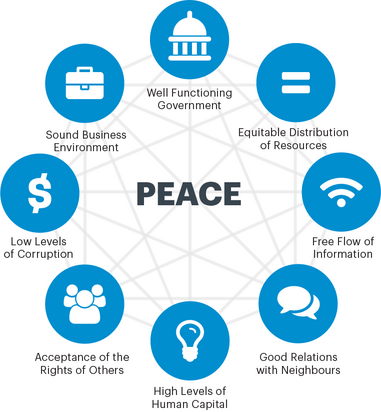
In order to construct the PPI, IEP analysed over 50,000 different data series, indices and attitudinal surveys in conjunction with current thinking about the drivers of violent conflict, resilience and peacefulness. The result is an eight-part taxonomy of the factors associated with peaceful societies. The eight domains, or Pillars of Positive Peace, were derived from the data series that had the strongest correlation with internal peacefulness as measured by the GPI, an index that defines peace as “absence of violence or the fear of violence”. Each of the eight PPI Pillars is measured by three indicators. These represent the best available globally- comparable data with the strongest statistically significant relationship to levels of peace within a country.